Mumbai Real Estate: Can Luxury Growth and Affordable Housing Coexist?
 Admin
Admin
- 2025-12-19
- 1231
- 0

Never miss any update
Join our WhatsApp Channel
Mumbai stands at an important turning point. The city is growing fast with new metro lines, sea links, and airports. Property prices are rising, especially for luxury homes. But millions of middle-class families still struggle to buy a house they can afford.
This raises a big question: Can Mumbai's real estate market grow its luxury segment while also building homes that regular families can buy?
Let us explore this challenge in detail.
Why Mumbai Real Estate Is Growing So Fast
Mumbai is experiencing one of its biggest development phases in decades. Several factors are driving this growth across the Mumbai Metropolitan Region infrastructure revolution.
Major Infrastructure Projects
The city is investing heavily in connectivity:
- Mumbai Metro Expansion: Multiple new lines connecting suburbs to the city centre, with the Metro Line 3 reshaping real estate in Bandra, Khar and South Mumbai
- Mumbai Trans Harbour Link (MTHL): The 21.8 km sea bridge connecting Mumbai to Navi Mumbai real estate destinations
- Navi Mumbai International Airport: Expected to reduce travel time and open new residential zones, as detailed in the Navi Mumbai International Airport property investment guide
- Coastal Road Project: Faster north-south connectivity along the western coastline, with the Mumbai Coastal Road tunnel now open from Dadar to Nariman Point
These projects are reducing travel time across the Mumbai Metropolitan Region (MMR) and opening up new areas for residential development.
Improved Regulations
The Maharashtra government has simplified several approval processes:
- Faster redevelopment approvals for old buildings
- Single-window clearance for housing projects
- Revised FSI (Floor Space Index) norms in Mumbai benefiting builders
- Cluster redevelopment schemes gaining momentum
Strong Investor Confidence
Despite global economic uncertainty, Mumbai continues to attract both domestic and international real estate investors. The city's position as India's financial capital makes it a safe bet for long-term investment, as explored in the top 5 real estate hotspots in Mumbai for smart investment.
The Luxury Market Is Booming
Mumbai's luxury housing segment has seen remarkable growth. Premium apartments in areas like South Mumbai, Worli, Bandra West, and Lower Parel are selling at record prices. For a comprehensive analysis, read about Mumbai's luxury real estate market trends.
Current Luxury Market Trends
| Location | Average Price Per Sq Ft | Typical Apartment Size | Total Cost Range |
|---|---|---|---|
| South Mumbai | ₹75,000 - ₹1,50,000 | 2,000 - 5,000 sq ft | ₹15 Cr - ₹75 Cr |
| Worli | ₹55,000 - ₹85,000 | 1,500 - 4,000 sq ft | ₹8 Cr - ₹35 Cr |
| Bandra West | ₹50,000 - ₹75,000 | 1,200 - 3,000 sq ft | ₹6 Cr - ₹22 Cr |
| Lower Parel | ₹45,000 - ₹65,000 | 1,500 - 3,500 sq ft | ₹7 Cr - ₹23 Cr |
Who Is Buying Luxury Homes?
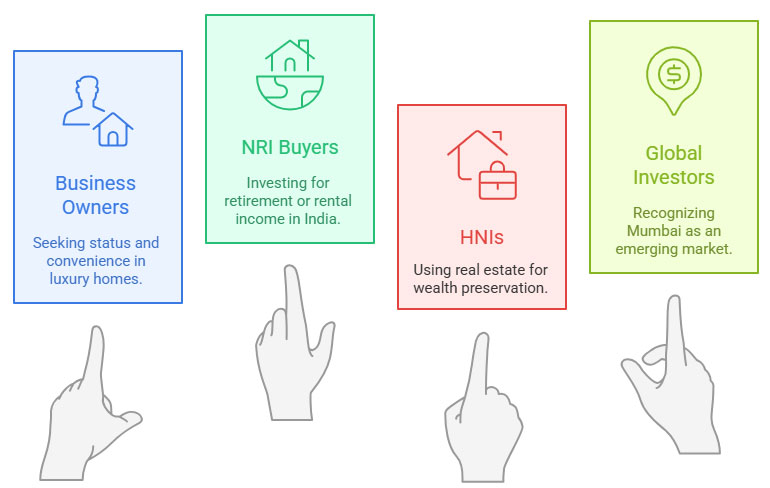
The luxury segment attracts several buyer categories:
- Business owners and senior executives: Looking for status and convenience
- NRI buyers: Investing in premium properties for retirement or rental income, as detailed in where NRIs should invest in India for property growth
- HNIs (High Net Worth Individuals): Treating real estate as a wealth preservation tool, with insights from India's ultra-wealthy betting big on luxury homes
- Global investors: Seeing Mumbai as an emerging market opportunity
Why Luxury Sales Keep Rising
Several factors support the luxury boom:
- Limited supply in prime locations: South Mumbai and Bandra have almost no new land available
- Status symbol: Owning a luxury apartment remains a mark of success, as seen in branded residences vs traditional luxury real estate in India
- Amenities: World-class facilities including private pools, concierge services, and smart home features
- Capital appreciation: Premium properties tend to hold value better during market downturns
The Affordable Housing Crisis
While luxury sales grab headlines, the real story of Mumbai housing is the struggle of ordinary families. The Mumbai home ownership crisis reveals why buying property has become nearly impossible for many.
Affordability Index: Mumbai vs Other Cities
Mumbai has the highest affordability index among Indian metros. This means homebuyers need to spend a larger portion of their income on housing compared to other cities.
| City | Average Property Price | Average Annual Income | Affordability Ratio |
|---|---|---|---|
| Mumbai | ₹1.35 Crore | ₹12 Lakh | 11.2x |
| Delhi NCR | ₹85 Lakh | ₹10 Lakh | 8.5x |
| Bangalore | ₹78 Lakh | ₹11 Lakh | 7.1x |
| Pune | ₹65 Lakh | ₹9 Lakh | 7.2x |
| Chennai | ₹55 Lakh | ₹8 Lakh | 6.9x |
A healthy affordability ratio is considered to be around 3-5x. Mumbai's ratio of over 11x shows how difficult it is for average earners to buy a home.
Why Are Mumbai Homes So Expensive?
Several factors push prices beyond the reach of middle-class families:
1. High Land Costs
Mumbai has limited land. The city is surrounded by water on three sides, leaving little room for horizontal expansion. This scarcity drives land prices up.
2. Heavy Government Charges
Homebuyers pay multiple charges that add 15-20% to the base property cost. Understanding property registration charges and stamp duty in India is essential:
- Stamp duty: 5-6% of property value
- Registration charges: 1% of property value
- GST on under-construction properties: 5% (with conditions)
- Development charges and premium
- Infrastructure cess
3. High Construction Costs
Building in Mumbai is more expensive than other cities due to:
- Strict BMC (Brihanmumbai Municipal Corporation) regulations
- Higher labour costs
- Premium material requirements for high-rises
- Complex approval processes
4. Limited Affordable Housing Supply
Most developers focus on premium and luxury segments because profit margins are higher. Affordable housing projects face lower profit margins, longer approval timelines, and difficulty finding suitable land parcels. Learn more about the complete guide to affordable housing projects and PMAY benefits in India.
Impact on Mumbai's Workforce
The housing crisis affects Mumbai's economy in several ways:
- Long commutes: Workers live far from their workplaces to afford housing
- Brain drain: Talented professionals move to other cities with better affordability
- Informal housing: Slums and unauthorised constructions grow due to lack of affordable options
- Reduced disposable income: Families spend most of their earnings on rent or EMIs
Redevelopment: Mumbai's Answer to Land Scarcity
Unlike other Indian cities, Mumbai cannot expand horizontally. The solution lies in going vertical through redevelopment of old buildings, as explained in 7 reasons why societies should consider self-redevelopment.
How Redevelopment Works
- Identification: Old buildings (typically 30+ years) are identified for redevelopment
- Resident approval: At least 51% of existing residents must agree (reduced from earlier 70%)
- Developer selection: A builder is chosen to execute the project
- Rehabilitation: Existing residents get new apartments (usually larger than original)
- Sale component: Additional floors are built and sold to fund the project
Recent Policy Changes Helping Redevelopment
The Maharashtra government has made redevelopment easier:
| Policy Change | Impact |
|---|---|
| Reduced consent requirement (51%) | Faster project approvals |
| Cluster redevelopment rules | Entire neighbourhoods can be transformed |
| Extended timelines for project completion | Developers get more flexibility |
| Higher FSI allowances | More floors can be built |
| Simplified approval process | Reduced red tape |
Expected Redevelopment Supply
Over the next decade, redevelopment is expected to add significant housing supply:
- BDD Chawls Redevelopment: 16,000+ new homes in Central Mumbai
- MHADA Colony Redevelopment: Thousands of new apartments across the city, with MHADA transforming Mumbai's housing landscape with 45,000 new homes
- Private Building Redevelopment: Lakhs of homes across aging societies
This new supply could help stabilise prices by increasing availability. The Dharavi redevelopment project alone will deliver 50,000 homes.
Mixed Housing: The Need for a Balanced Approach
Developers who focus only on luxury housing face market risks. A more sustainable strategy includes multiple housing segments, as evidenced by Mumbai real estate developers pivoting to affordable housing.
Why Developers Should Diversify
Market Cycles: Luxury sales slow down during economic uncertainty, while affordable housing demand remains steady.
Government Incentives: Affordable housing projects receive benefits under PMAY (Pradhan Mantri Awas Yojana) including lower GST rates and interest subsidies. Read the PMAY complete guide to benefits and application process.
Broader Customer Base: A mixed portfolio allows developers to serve multiple income groups.
Social Responsibility: Building affordable homes contributes to city development and improves brand image.
The Ideal Housing Mix
Experts suggest a balanced approach for large developers:
| Segment | Target Audience | Price Range | Suggested Portfolio Share |
|---|---|---|---|
| Luxury | HNIs, NRIs | Above ₹3 Crore | 20-25% |
| Premium | Upper middle class | ₹1.5 - 3 Crore | 25-30% |
| Mid-segment | Middle class | ₹75 Lakh - 1.5 Crore | 30-35% |
| Affordable | First-time buyers | Below ₹75 Lakh | 15-20% |
Rental Housing: An Untapped Opportunity
Mumbai desperately needs quality rental housing. Current challenges include:
- Outdated rent control laws: Discourage property owners from renting
- Informal rental market: Lack of legal protections for tenants
- Limited purpose-built rental housing: Most rentals are individual-owned apartments
The Model Tenancy Act 2025 aims to improve this situation. Developers who invest in rental housing now could benefit from this growing market.
Infrastructure Is Changing Where People Live
Mumbai's definition is expanding. Areas once considered too far are now becoming prime residential locations.
How Connectivity Changes Property Value
| Area | Before Metro/MTHL | After Connectivity | Price Change |
|---|---|---|---|
| Thane | ₹12,000/sq ft | ₹18,000/sq ft | +50% |
| Panvel | ₹6,000/sq ft | ₹9,500/sq ft | +58% |
| Ulwe | ₹5,500/sq ft | ₹8,500/sq ft | +55% |
| Kalyan | ₹7,000/sq ft | ₹10,500/sq ft | +50% |
Emerging Micro-Markets
Several areas are becoming attractive alternatives to expensive central locations:
Navi Mumbai
- Proximity to upcoming international airport
- Planned smart city development
- Lower prices compared to Mumbai proper
- Growing commercial and IT hub presence
Explore Navi Mumbai real estate as a top investment destination and discover why Kharghar is Navi Mumbai's top property investment spot.
Thane and Beyond
- Metro connectivity improving access through Thane Metro Line 9
- Established social infrastructure
- Family-friendly environment
- 30-40% cheaper than equivalent Mumbai locations
Read the comprehensive Mumbai suburbs real estate boom analysis and the Kalyan Thane real estate guide.
Western Corridor (Virar to Vasai)
- Mumbai Metro Line 9 improving connectivity
- Large land parcels available for development
- Affordable pricing for budget-conscious buyers
- Growing industrial and commercial presence
Discover Virar real estate for affordable homes with strong growth in the Mumbai MMR.
Central Suburbs (Mulund to Kalyan)
- Metro Line 4 and 5 improving access
- Established residential communities
- Mix of redevelopment and new construction
- Good schools and hospitals already present
Explore the Mulund property market rates and growth trends.
Housing Cannot Exist in Isolation
A successful residential project needs more than just apartments. Mumbai's growth requires integrated development across multiple sectors.
Supporting Infrastructure Requirements
Healthcare
- More hospitals and clinics in new residential zones
- Specialty care facilities spreading beyond South Mumbai
- Emergency services coverage in emerging areas
Education
- Quality schools in developing suburbs
- Higher education institutions moving to MMR periphery
- Vocational training centres for workforce development
Commercial Spaces
- Office complexes creating employment near residential areas
- Retail and shopping destinations reducing travel needs
- Co-working spaces supporting the gig economy
Recreation and Open Spaces
- Parks and playgrounds for families
- Sports facilities and fitness centres
- Entertainment and cultural venues
The Concept of 15-Minute Cities
Global urban planning is moving towards 15-minute cities where residents can access all essential services within a 15-minute walk or cycle ride. Mumbai can learn from this approach:
- Mixed-use zoning: Allowing residential, commercial, and retail in the same area
- Walkable neighbourhoods: Reducing dependence on vehicles
- Local employment: Offices closer to residential areas
- Community facilities: Schools, clinics, and markets within walking distance
Government's Role in Balancing Growth
The state and central governments must play an active role in ensuring balanced development. The Majhe Ghar Majha Adhikar Housing Policy outlines ₹70,000 Cr plan for 35 lakh affordable homes in Maharashtra.
Policy Interventions Needed
1. Affordable Housing Mandates
Require large projects to reserve a percentage of units for affordable housing, similar to policies in Singapore and the UK.
2. Tax Incentives
- Reduced stamp duty for first-time homebuyers purchasing affordable units, as seen in Maharashtra's stamp duty reduction for senior living homes
- GST exemptions for affordable housing projects
- Property tax benefits for developers building rental housing
3. Land Allocation
- Release more government land for affordable housing
- Priority allocation for projects targeting lower income groups
- Land banking strategies for future development
4. Streamlined Approvals
- Faster clearances for affordable housing projects
- Single-window clearance for projects meeting affordability criteria
- Reduced premium charges for developers building affordable units
5. Rental Housing Support
- Implementation of Model Tenancy Act provisions
- Incentives for building purpose-built rental housing
- Rental subsidy schemes for low-income workers
What Homebuyers Should Consider
For those looking to buy property in Mumbai, here are some practical considerations:
If Your Budget Is Below ₹1 Crore
Focus on:
- Emerging locations along new metro lines
- Panvel area as Mumbai's smart investment hub near new airport
- Thane West and extended suburbs
- MHADA lottery schemes - check MHADA Mumbai lottery for affordable homes starting at ₹30 Lakh
- Resale properties in established societies
If Your Budget Is ₹1-3 Crore
Consider:
- Upcoming redevelopment projects in central locations
- Premium projects in Mulund or Powai
- Navi Mumbai's developing nodes like Kharghar
- Early-stage projects in areas with planned infrastructure
If Your Budget Is Above ₹3 Crore
Options include:
- Established luxury projects in South Mumbai and Bandra
- New luxury launches in Worli and Lower Parel
- Premium sea-facing properties
- Branded residences from international developers, as highlighted in Mumbai leading India's branded residence revolution
General Tips for All Buyers
- Check RERA registration: Verify the project on MahaRERA portal as explained in new RERA rules complete guide for Indian homebuyers
- Study connectivity plans: Upcoming metro and road projects add value
- Verify builder track record: Past project delivery and quality matter
- Understand total costs: Include stamp duty, registration, GST, and maintenance - use the Mumbai Ready Reckoner rates guide and stamp duty calculator
- Consider resale potential: Location and amenities affect future value
Looking Ahead: Mumbai's Real Estate Future
Mumbai's real estate market will continue to evolve. Here are key trends to watch:
Short-Term (1-3 Years)
- Continued luxury market strength in prime locations
- Increased redevelopment activity in central Mumbai
- New launches in areas connected by recent metro lines
- Growing demand for larger homes post-pandemic
Medium-Term (3-7 Years)
- Navi Mumbai airport opening transforming nearby real estate
- MTHL impact on Navi Mumbai property values
- Significant redevelopment supply entering the market
- Potential price stabilisation due to increased supply
Long-Term (7-15 Years)
- Mumbai truly becoming a metropolitan region rather than just a city
- Emergence of multiple business districts reducing central Mumbai dependency
- Smart city features becoming standard in new developments
- Possible shift towards rental and co-living models for young professionals
Conclusion
Mumbai is at a crossroads. The city can choose to grow only for the wealthy, or it can build a more inclusive housing market that serves all income groups. The Mumbai housing crisis guide to affordable solutions and government schemes offers hope for balanced growth.
The ingredients for success are present: massive infrastructure investment, simplified regulations, and strong demand. What is needed is the will to balance luxury growth with affordable housing.
Developers who diversify their portfolios will be better positioned for long-term success. Policymakers who support affordable housing will build a more resilient city. And homebuyers who look beyond traditional locations will find value in emerging areas across Thane, Navi Mumbai, and the extended Mumbai Metropolitan Region.
Mumbai's future does not lie in choosing between luxury and affordability. It lies in finding ways for both to coexist. A city where a banker in Worli and a teacher in Virar can both own their dream homes is a city that truly works.


Comments
No comments yet.
Add Your Comment
Thank you, for commenting !!
Your comment is under moderation...
Keep reading blogs