- Blog
- Research & Reports
- Mumbai
The Global Real Estate Portal Intelligence Report
 Priya Kataria
- 2026-03-01 22:18:53
- 1229
- 0

Never miss any update
Join our WhatsApp Channel
How Category Ownership, Media Power & Data Moats Shape Global Property Markets
By Ghar.tv
Introduction: Owning the Word Is the New Owning the Land
In real estate, owning land has always been power.
In the digital era, owning the word that represents land has become just as powerful.
Across the world, a handful of portals have captured entire national markets — not just through listings, but through language. They embedded themselves into consumer vocabulary.
When buyers say "search homes," they often mean:
- Homes.com
- Zillow.com
- Realtor.com
In Australia, property discovery is synonymous with:
- Realestate.com.au
In the UK, it is:
- Rightmove.co.uk
In India, the market is divided between:
- Magicbricks.com
- 99acres.com
- Housing.com
But here is the deeper question:
Why do some markets consolidate into one dominant portal while others remain fragmented?
Why do generic domains consistently enjoy structural advantages?
And what does this mean for the future of real estate discovery?
This report studies the economics, psychology, and strategic architecture behind the world's leading real estate portals and what it signals for the next decade of proptech evolution in India and beyond.
Section I: Portal Archetypes - How Markets Are Captured
Global real estate portals typically fall into five strategic archetypes. Understanding these patterns is key to predicting where the industry is headed.
1. Generic Domain Dominance
Category Ownership Through Language
Examples:
- Homes.com (United States)
- Realestate.com.au (Australia)
These platforms benefit from owning category-defining words. The brand equals the product.
Structural Advantages:
- Instant recall
- Lower friction in consumer adoption
- Strong direct traffic
- Psychological trust through neutrality
Generic domains function like digital commercial property. They represent category authority before a single marketing dollar is spent.
Homes.com - The CoStar-Backed Category Play
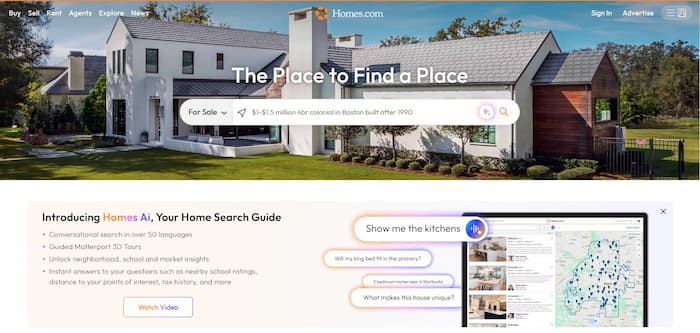
Homes.com represents perhaps the purest expression of category ownership in residential real estate. Backed by CoStar Group - one of the world's largest commercial property data companies, Homes.com was relaunched in 2023 with a clear strategic premise: own the noun. The domain itself communicates intent before a single brand impression is served, eliminating the cognitive step that branded portals must bridge.
CoStar's relaunch invested heavily in agent-centric positioning under the "Your listing, your lead" model, directly challenging Zillow's lead-redistribution approach. Its generic name lowers consumer friction, while CoStar's underlying data infrastructure provides the B2B depth typically associated with subscription-model platforms, making it one of the few portals that competes across multiple archetypes simultaneously.
Realestate.com.au — The Winner-Takes-All Blueprint
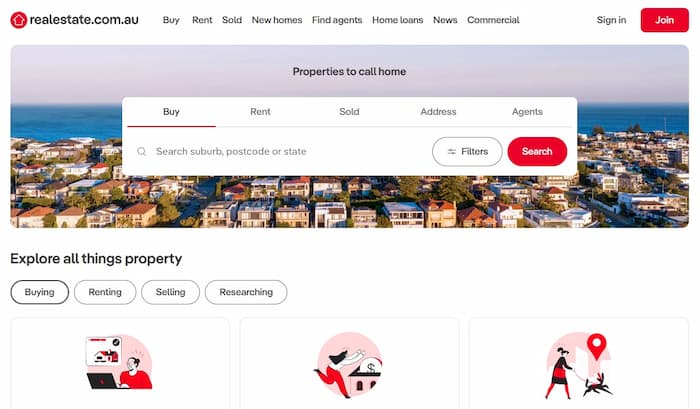
Realestate.com.au, operated by REA Group, is arguably the most dominant residential portal in any developed market by relative market share. In Australia, it is not simply the market leader - for most buyers and renters, it is the only destination they consider. This winner-take-all outcome reflects the compounding advantage of a generic, trust-neutral domain in a geographically concentrated, high-property-value market.
REA Group has leveraged this domestic dominance internationally, acquiring stakes in portals across India, Southeast Asia, and the United States. Its financial model - charging agents and developers significant subscription and listing fees, with minimal negotiating leverage on the supply side - is a textbook case of marketplace monopoly economics in action.
2. Brand-Built Market Titans
Brand > Generic
Examples:
- Zillow (United States)
- Rightmove (United Kingdom)
These platforms did not rely on generic naming. Instead, they built massive brand equity through:
- Advertising scale
- Data integration
- Agent subscription models
- Consumer habit formation
Over time, repetition made the brand synonymous with property search. Understanding the powerful techniques behind real estate marketing reveals how these titans achieved dominance.
Key Insight: Brand dominance can outperform generic naming — if supported by data and scale.
Zillow - The Zestimate That Built an Empire
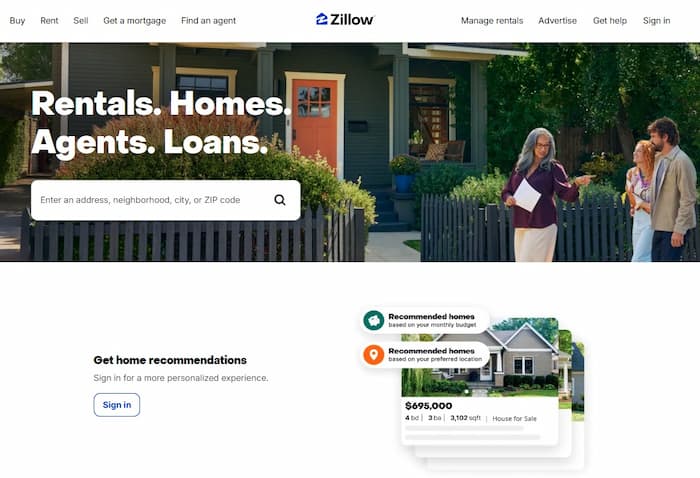
Zillow is the defining case study in brand-over-domain dominance. Founded in 2006, it built consumer trust through one radical product decision: publishing the Zestimate, an automated home valuation available to anyone, for free. This single feature drove massive direct traffic, made Zillow indispensable to curious homeowners, and embedded the brand into American real estate culture before most competitors understood what was happening. Despite a high-profile and costly exit from its iBuying programme in 2021, Zillow has remained the most visited residential real estate portal in the United States - a testament to the durability of consumer habit once formed at scale. Its recovery underlines a core truth: data-led brand equity, once established, is extraordinarily difficult to dislodge.
Rightmove - The Inescapable Infrastructure
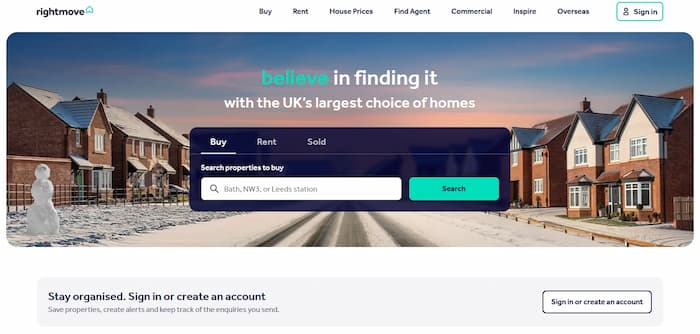
Rightmove's dominance in the UK is so complete that estate agents have long described its fees as non-negotiable - an unavoidable cost of doing business, comparable to rent or utilities. Founded in 2000 by a consortium of major UK estate agency chains, Rightmove benefited from coordinated early supply-side adoption that immediately gave it the deepest listing inventory in the market.
Over two decades, it has consistently captured over 80% of UK property search traffic. Its operating profit margins, routinely above 70%, are among the highest of any listed portal globally, a direct reflection of how inelastic agent demand becomes once a platform fully owns the consumer relationship.
Repeated challenges from Zoopla and OnTheMarket have failed to meaningfully shift this dynamic.
3. Media-Backed & Conglomerate Ecosystems
Listings + Classified Heritage + Editorial Integration
Examples:
- Realtor.com (United States)
- Property24 (South Africa)
These portals benefit from association with large media or classifieds ecosystems.
Structural Strength:
- Built-in audience channels
- Cross-platform advertising
- Brand legitimacy
- Integrated content distribution
Media backing strengthens authority. Listings become part of a broader ecosystem.
Realtor.com - Institutional Legitimacy as a Competitive Moat
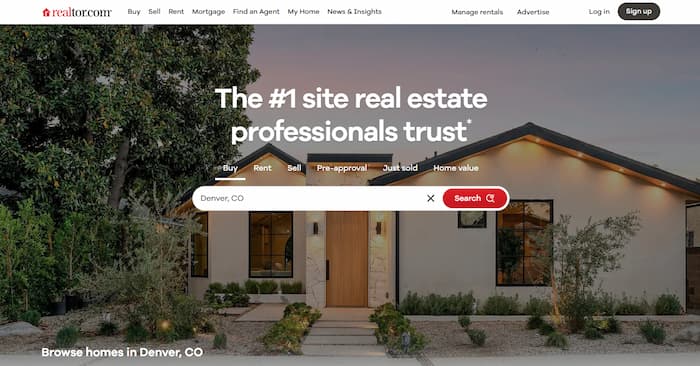
Realtor.com occupies a structurally unique position in the US market: it operates under a formal agreement with the National Association of Realtors (NAR), the most powerful real estate trade body in the country. This institutional backing historically granted it privileged access to MLS listing data — the most accurate and timely feed of active inventory available anywhere. Operated by Move, Inc. and backed by News Corp, Realtor.com benefits from both regulatory legitimacy and the distribution muscle of a global media conglomerate. While it has consistently ranked second behind Zillow in consumer traffic, its data accuracy and professional trust credentials have made it the preferred platform for serious, transaction-ready buyers — a distinction that raw traffic numbers do not fully capture.
4. Regional Expansion Platforms
Multi-Market Scale Across Emerging Regions
Examples:
- PropertyGuru (Singapore & Southeast Asia)
- Property Finder (UAE & Middle East)
These platforms expanded across neighbouring geographies rather than dominating only one country.
Growth Model:
- Developer-focused monetisation
- Performance marketing heavy
- Classified marketplace engine
- Regional brand leverage
This archetype thrives in fast-growing markets with high cross-border investor activity. The evolution of Dubai real estate is a prime example, with Dubai recording record-breaking sales in 2025. Indian investors have also been eyeing windfall gains in UK property and global markets.
5. Subscription & Data-Driven Moats
Stable Revenue Through B2B Depth
Example:
- ImmobilienScout24 (Germany)
These platforms emphasise:
- Agent subscriptions
- Enterprise tools
- Data services
- Structured monetisation
The result is recurring revenue and strong profitability in mature markets. Global platforms like CBRE have similarly introduced data and tech driven development solutions to strengthen their B2B moat.
Section II: India - The Fragmented Mega-Market
India presents a unique case.
Unlike Australia or the UK, no single portal has fully captured category language or national dominance.

Magicbricks, 99acres, and Housing.com compete aggressively in performance marketing. In fact, regulatory developments such as orders on realty portals listing as agents are reshaping how these portals operate. The result:
- High acquisition costs
- Fragmented consumer loyalty
- Competitive pricing pressure
- Rapid innovation cycles
This fragmentation creates both challenge and opportunity. The rise of platforms like Blox raising INR 100 crore, Homexchange securing USD 4 million, and the impact of Zapkey's funding on the proptech market shows that India's landscape is rapidly evolving.
The Indian market is large enough to support multiple players - but still open enough for differentiated models to emerge. The HDFC Capital proptech fund investing in 15 enterprises underscores the institutional appetite for Indian proptech.
Section III: The Economics Behind Portal Power
Across global markets, dominant portals typically build power through four layers:
1. Listings Layer
- Inventory aggregation
- Lead generation
- Transaction facilitation
2. Advertising Layer
- Agent monetisation
- Developer packages
- Premium placement
Understanding proptech monetization beyond the listing fee model is crucial for platforms seeking sustainable revenue.
3. Data & Intelligence Layer
- Pricing insights
- Market analytics
- Consumer behaviour modelling
The emergence of digital connectivity ratings transforming commercial real estate is a clear indicator of this layer's growing importance. Similarly, data centre growth is propelling investment in Indian real estate.
4. Media & Trust Layer
- Editorial content
- Market reports
- Thought leadership
- Community engagement
The strongest portals operate across all four layers. Listings are the hook. Data is the moat. Media is the trust engine.
Section IV: The Evolution of Real Estate Portals
The industry has undergone three structural waves:
Wave 1: Digitisation of Listings
Portals replaced newspaper classifieds. India's property markets have transformed dramatically during this period - explore the evolution of Mumbai real estate, the evolution of Navi Mumbai real estate, and the evolution of Chennai real estate over the last decade.
Wave 2: Marketplace & Advertising Expansion
Lead monetisation and performance marketing accelerated growth.
Wave 3: Data & Ecosystem Integration
Pricing models, analytics, and subscription products emerged. Platforms like Arvind SmartSpaces launched comprehensive digital sales platforms, while NestAway's acquisition by Aurum PropTech signalled consolidation in the ecosystem.
We are now entering Wave 4:
Wave 4: Intelligence & Understanding
As AI reshapes discovery, consumers increasingly demand:
- Legal clarity
- Infrastructure insight
- Risk assessment
- Market context
- Long-term decision support
Discovery alone is no longer sufficient. Understanding becomes the differentiator. The future of Indian real estate with AI, VR and blockchain is driving this shift. From blockchain applications in property portals to AI making real estate brokers stronger, intelligence is now the competitive frontier.
Section V: Where Ghar.tv Fits in the Global Matrix
If generic portals captured search, the next generation may capture understanding.
Ghar.tv is positioned at the intersection of:
- Media-layer real estate
- Intelligence tools & calculators
- Market insight & analysis
- Community engagement through curated live events
Rather than competing purely on listings, the focus shifts toward:
- Explaining markets
- Simplifying complexity
- Providing legal & regulatory clarity
- Decoding infrastructure growth
- Delivering decision intelligence
This is why understanding the property portal technology stack matters - it determines whether a platform can deliver intelligence at scale. Innovations like Aadhaar eSignatures in real estate transactions and India's digital property revolution are building this intelligence layer.
Search can be bought. Trust compounds. Understanding scales.
The Central Thesis
Generic domains accelerate category capture. Brand titans build dominance through repetition. Media-backed players create authority through ecosystem strength. Regional platforms expand across high-growth corridors. Subscription giants stabilise through B2B monetisation.
The next structural shift may not be about who owns the most listings. It may be about who owns the clearest understanding.
Real estate decisions are high-value, high-emotion, high-risk choices. The platforms that simplify complexity will define the next decade. For those looking to understand the investment landscape, explore essential strategies for smart real estate investment and common ways to profit from real estate in India.
Conclusion
The global portal economy is not static. It evolves with technology, regulation, and consumer behaviour.
The first wave digitised access. The second wave monetised attention. The third wave integrated data. The fourth wave may integrate intelligence.
The future of property discovery will not belong solely to those who aggregate inventory but to those who aggregate clarity.
This report marks the beginning of a deeper exploration into how global portal power structures shape markets and how new models may redefine them. As proptech continues to revive real estate in India, the most forward-looking platforms are already building for the intelligence era. Breakthroughs like India's first blockchain-powered property project and the growing wave of non-metro cities emerging as commercial real estate hotspots signal that the next chapter is already being written.
With Indian real estate giants achieving record sales in FY25, the market's scale and momentum are undeniable. The platforms that combine data, intelligence, and trust will lead this transformation.
Published by Ghar.tv
India's Understanding-First Real Estate Platform
Explore India's leading property markets: Mumbai | Bengaluru | Hyderabad | Pune | Chennai | Gurugram | Noida | Navi Mumbai | Thane | Ahmedabad | Kolkata | New Delhi | Dubai



Comments
No comments yet.
Add Your Comment
Thank you, for commenting !!
Your comment is under moderation...
Keep reading blogs