Navi Mumbai International Airport Impact on Real Estate: Investment Guide for Smart Buyers
 Admin
Admin
- 2025-12-20
- 1761
- 0

Never miss any update
Join our WhatsApp Channel
The Navi Mumbai International Airport (NMIA) has finally become a reality. After decades of planning and years of construction, Prime Minister Narendra Modi inaugurated the airport on October 8, 2025, with commercial flights scheduled to begin from December 25, 2025. This landmark project is not just transforming air travel in the Mumbai Metropolitan Region but is fundamentally reshaping the real estate landscape across Navi Mumbai and surrounding areas.
For homebuyers, investors, and developers, NMIA represents a once-in-a-generation opportunity. The airport has already triggered significant property appreciation and is expected to fuel sustained growth for years to come. This comprehensive guide explores how NMIA is impacting real estate across different micro-markets, what buyers can expect, and where the smartest investment opportunities lie.
What Makes NMIA a Game Changer for Mumbai
The Navi Mumbai International Airport addresses a critical need that Mumbai has faced for decades. The existing Chhatrapati Shivaji Maharaj International Airport (CSMIA) handles over 50 million passengers annually and operates at near-full capacity. NMIA, located approximately 35 kilometres from the existing airport near Panvel, provides much-needed relief while opening up entirely new growth corridors.
Key Facts About NMIA
The airport spans approximately 1,160 hectares of land and represents an investment of roughly ₹16,700 crore. In its first phase, NMIA features a single 3,700-metre runway capable of handling wide-body aircraft and a passenger terminal designed to manage 20 million passengers annually. The terminal building showcases a distinctive lotus-shaped design created by the renowned Zaha Hadid Architects. Learn more about how the Zaha Hadid design is boosting real estate values.
Phase 2 will expand the airport's capacity to handle 60 to 65 million passengers, while Phase 3 aims to reach 90 million passengers and 2.5 million tonnes of cargo annually by 2032. The Adani Group manages the airport through Navi Mumbai International Airport Limited (NMIAL), a special purpose vehicle established in partnership with CIDCO. The airport is set to create over 60,000 jobs by 2037.
How Property Prices Have Changed Near NMIA
The anticipation of NMIA has already delivered substantial returns to early investors. Property values across Navi Mumbai's key micro-markets have appreciated significantly over the past five years, with the trend accelerating as the airport neared completion.
Price Growth in Key Locations
Ulwe, the area closest to the airport, has witnessed remarkable transformation. Five years ago, residential properties in Ulwe averaged around ₹5,500 to ₹6,500 per square foot. Today, prices in established sectors range from ₹9,000 to ₹13,000 per square foot, representing appreciation of 60 to 80 percent. Premium projects from reputed developers command even higher rates, touching ₹14,500 per square foot. Read our detailed analysis on Ulwe real estate growth with airport and MTHL boost.
Panvel, traditionally a more established market, has seen prices climb from approximately ₹6,000 per square foot to ₹9,500 to ₹11,500 per square foot during the same period. This 50 to 60 percent appreciation reflects Panvel's strategic position as the gateway to the airport zone. Our comprehensive guide on Panvel real estate as Mumbai's smart investment hub offers deeper insights.
Kharghar and Seawoods, already premium locations with excellent infrastructure, have experienced price growth of 35 to 45 percent. These areas now command rates of ₹12,000 to ₹18,000 per square foot depending on the project and location. Discover why Kharghar is Navi Mumbai's top property investment spot.
Dronagiri, positioned as a future growth corridor, offers relatively affordable entry points between ₹6,500 and ₹9,000 per square foot. Early investors in Dronagiri have already seen 40 to 55 percent appreciation, with significant upside potential as infrastructure develops.
What Drives These Price Increases
Several factors have combined to push property values higher across the NMIA influence zone. First, improved connectivity has made these areas more accessible. The Mumbai Trans Harbour Link (MTHL), also known as the Atal Setu, now connects Navi Mumbai directly to South Mumbai, cutting travel time from over two hours to approximately 20 minutes. Learn about the elevated corridor linking MTHL and Mumbai-Pune Expressway.
Second, Metro rail expansion has enhanced last-mile connectivity. The Navi Mumbai Metro Line 1 connecting Belapur to Pendhar operates through key nodes, while additional metro lines are under various stages of development.
Third, institutional investor interest has validated the market. Major developers including Lodha, Godrej, Hiranandani, and L&T have launched or acquired projects in the region, signalling confidence in long-term growth prospects. The NMIA project has transformed Navi Mumbai into a prime real estate destination.
Top Areas to Watch Near NMIA
Understanding which micro-markets offer the best opportunities requires analysing current infrastructure, planned developments, and price entry points. For a comprehensive overview, explore our Navi Mumbai property investment guide with best areas and prices.
Ulwe: The Airport's Backyard
Ulwe enjoys the closest proximity to NMIA, with some sectors located within 5 kilometres of the terminal. The area has transformed from an undeveloped zone into a rapidly emerging urban centre with residential towers, commercial complexes, and social infrastructure.
Current price range for residential properties spans ₹9,000 to ₹14,500 per square foot. Ulwe benefits from excellent road connectivity to the airport and the proposed Ulwe local railway station that will enhance connectivity further. Explore properties in Sector 19 Ulwe and Sector 20 Ulwe for promising investment options.
For buyers, Ulwe suits those seeking appreciation potential and proximity to the airport. End-users working in aviation, logistics, or hospitality sectors will find it particularly convenient.
Pushpak Nagar: Premium Airport Living
Pushpak Nagar represents NMIA's immediate neighbourhood, designed specifically to complement the airport ecosystem. This planned node features integrated development with residential, commercial, and retail components.
Property prices in Pushpak Nagar range from ₹10,500 to ₹15,000 per square foot for residential units. The area attracts professionals seeking premium living close to their workplace at the airport.
Panvel: Established Infrastructure Hub
New Panvel offers the advantage of existing infrastructure combined with strategic location. As a tehsil headquarters with decades of development, Panvel provides schools, hospitals, markets, and public transport options that newer areas lack. The Panvel-Karjat suburban rail corridor nears completion, further enhancing connectivity.
Current residential prices range from ₹9,500 to ₹11,500 per square foot for quality projects. Old Panvel and New Panvel East suit families seeking established social infrastructure while benefiting from airport proximity.
Dronagiri: Future Growth Corridor
Dronagiri represents perhaps the most interesting opportunity for long-term investors. Located along the Mumbai-Goa highway with proximity to the Jawaharlal Nehru Port Trust (JNPT), Dronagiri is positioned at the intersection of multiple growth drivers.
Current prices between ₹6,500 and ₹9,000 per square foot offer relatively affordable entry. The area suits investors with a five to seven year horizon who can accommodate ongoing infrastructure development. Read about why Navi Mumbai hotspots are turning into real estate goldmines.
Kharghar and Seawoods: Premium Alternatives
For buyers prioritising immediate livability over maximum appreciation potential, Kharghar and Seawoods offer excellent alternatives. These mature nodes feature complete infrastructure, established communities, and premium amenities. The ISKCON Kharghar temple has also enhanced the area's appeal.
Prices range from ₹12,000 to ₹18,000 per square foot depending on specific location and project. These areas suit end-users seeking quality of life combined with reasonable airport proximity. Explore Sector 12 Kharghar and Sector 19 Kharghar for premium options.
How Infrastructure Supports Real Estate Growth
NMIA's impact extends beyond the airport itself. The supporting infrastructure network amplifies real estate appreciation across a much wider area. Understanding how infrastructure projects reshape India's real estate market helps investors make informed decisions.
Mumbai Trans Harbour Link
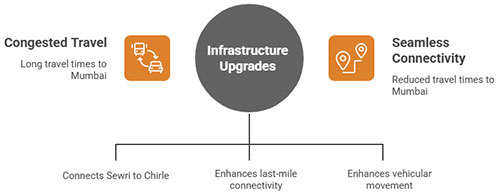
The MTHL represents India's longest sea bridge, spanning 21.8 kilometres across the Thane Creek. This engineering marvel connects Sewri in Mumbai to Chirle near Nhava Sheva, fundamentally changing connectivity dynamics for Navi Mumbai.
Before MTHL, reaching South Mumbai from areas like Panvel required navigating congested highways for two hours or more. Today, the same journey takes approximately 20 minutes via MTHL. This time savings has made Navi Mumbai locations viable for professionals working anywhere in Mumbai. The Mumbai infrastructure upgrades are significantly impacting travel and real estate.
Metro Rail Network
The Navi Mumbai Metro network continues expanding, enhancing last-mile connectivity across the region. Line 1 connecting Belapur to Pendhar began operations, providing crucial connectivity for commuters.
Additional lines under development will connect the airport to key nodes across Navi Mumbai and eventually link to the Mumbai Metro network. When complete, residents will enjoy seamless public transport access throughout the Mumbai Metropolitan Region. The Mumbai-Navi Mumbai airport connection via Metro-8 will transform connectivity by 2026.
Road Improvements
Major road projects complement rail connectivity. The Sion-Panvel Highway widening, the Navi Mumbai Airport Influence Notified Area (NAINA) road network, and improved arterial roads have significantly enhanced vehicular movement. Learn how CIDCO is building Maharashtra's next big property investment hub with NAINA.
For airport users specifically, dedicated access roads ensure smooth transit to and from the terminal. The connection to the Mumbai-Pune Expressway provides easy access for travellers from Pune and points south.
Township Projects Leading the Transformation
Large-scale integrated townships have emerged as the preferred development model in the NMIA influence zone. These self-contained communities offer comprehensive ecosystems that attract both end-users and investors. Explore the top projects in Third Mumbai for real estate investments.
What Townships Offer
Modern townships near NMIA typically include residential options across configurations from compact apartments to spacious villas. Beyond housing, they incorporate retail zones, commercial spaces, schools, healthcare facilities, recreational amenities, and green spaces within the development.
This integration appeals particularly to professionals relocating for airport-related employment. Rather than cobbling together housing, schools, and services from different locations, township residents find everything within their community.
Performance Comparison
Historical data suggests townships in airport zones deliver superior returns compared to standalone buildings. Analysis of comparable developments indicates townships have typically appreciated 20 to 30 percent more than independent projects over five-year periods.
Several factors explain this premium performance. Townships benefit from professional maintenance that preserves property values. The critical mass of residents supports commercial establishments that enhance convenience. And the comprehensive amenity package appeals to a broader buyer pool when owners eventually sell.
Notable Township Developments
Major developers have launched significant township projects across the NMIA zone. These developments range from hundreds to thousands of acres and will house tens of thousands of families when complete. For project recommendations, explore our guide on best localities in Third Mumbai for property investment.
While specific project recommendations depend on individual requirements and current availability, buyers should prioritise developers with strong track records, clear title documentation, and demonstrated construction progress.
Commercial Real Estate Opportunities
NMIA is catalysing commercial development across multiple segments. Understanding these opportunities helps investors diversify beyond residential real estate. Read about best places to buy commercial property in Mumbai for passive income.
Office Spaces
Corporate demand for office space in the NMIA zone is expected to grow significantly. Aviation companies, logistics providers, hospitality chains, and service businesses supporting airport operations all require commercial facilities. The Dow India lease in Navi Mumbai's Mindspace SEZ demonstrates growing corporate interest.
Rental yields for commercial properties typically exceed residential yields, often ranging from 7 to 10 percent annually compared to 2 to 4 percent for housing. However, commercial investments require higher capital commitment and carry different risk profiles.
Retail Properties
The expanding residential population supports growing retail demand. Neighbourhood shops, shopping centres, and high-street retail formats all present opportunities.
Retail investments suit investors seeking regular rental income. Success depends heavily on location selection and tenant quality.
Warehousing and Logistics
Proximity to both NMIA and JNPT creates exceptional logistics opportunities. E-commerce growth and increasing air freight volumes drive demand for modern warehousing facilities. Read about Maharashtra emerging as a national logistics hub.
Institutional investors have acquired significant logistics land parcels in the region. Individual investors can participate through fractional ownership platforms or listed real estate investment trusts focusing on logistics assets.
Hospitality Properties
Airport zones globally attract hotel development to serve business travellers, transit passengers, and tourists. The NMIA zone will likely see significant hotel supply additions over coming years.
While direct hotel investment remains complex, investors can gain exposure through publicly traded hospitality companies or real estate investment trusts with hotel portfolios.
Investment Considerations for Different Buyer Types
Different investors have varying objectives, time horizons, and risk tolerances. Understanding how NMIA fits different investor profiles helps in making appropriate decisions. Our ultimate first-time home buyer guide for India provides comprehensive guidance.
First-Time Homebuyers
For individuals purchasing their first home, NMIA zone locations offer attractive possibilities. Relative affordability compared to Mumbai proper, improving infrastructure, and appreciation potential make the proposition compelling. Review our essential home buying checklist before making decisions.
First-time buyers should prioritise projects from established developers with clear approvals and demonstrated construction capability. Ready-to-move or near-completion projects reduce execution risk.
Budget recommendations for first-time buyers in the NMIA zone typically start from ₹55 lakh for compact configurations in developing areas like Dronagiri, ranging to ₹1.2 crore or more for family-sized apartments in established nodes like Kharghar. Understand the hidden costs of buying a home in India before investing.
Investment Buyers
Investors seeking capital appreciation find strong prospects across the NMIA zone. Areas like Ulwe and Panvel offer balance between current livability and appreciation potential. Dronagiri suits investors with longer horizons who can wait for infrastructure development. Review smart ideas to maximize real estate investment returns.
Investment buyers should analyse comparable transactions, rental yields, and infrastructure timelines before committing. Diversifying across two or three locations reduces concentration risk. Our guide on smart property investment to build wealth offers practical strategies.
NRI Buyers
Non-resident Indians represent a significant buyer segment for NMIA zone properties. Improved connectivity to the international airport enhances convenience for NRIs visiting family or considering eventual return migration. The comprehensive NRI guide to buying property in India covers tax rules and legal processes.
NRI buyers should work with trusted local representatives for site visits and documentation. Understanding repatriation rules and tax implications is essential before purchase. Read about 10 essential factors for NRI property investment and explore best cities for NRI property investment.
High Net Worth Investors
Affluent investors can consider larger land parcels, commercial developments, or portfolio approaches combining multiple properties. These strategies offer potentially higher returns but require sophisticated analysis and management. Learn about why India's ultra-rich are betting on ultra-luxury real estate.
Professional advisory services add value for complex transactions. Legal due diligence becomes particularly important for land investments.
Risks and Challenges to Consider
While NMIA creates compelling opportunities, prudent buyers should understand potential risks and challenges.
Execution and Timeline Risks
Infrastructure projects in India sometimes face delays. While NMIA itself has commenced operations, supporting infrastructure like Metro extensions and road projects may take longer than announced timelines.
Buyers should factor potential delays into investment horizons. Properties in areas with existing infrastructure carry lower execution risk.
Market Cycle Considerations
Real estate markets move in cycles. Prices that have appreciated significantly may consolidate before the next upward move. Buyers entering at peak prices may experience flat returns in the short term even if long-term prospects remain positive.
Staggered investments over time reduce timing risk. Buyers with flexibility can negotiate better terms during slower market periods.
Project-Specific Risks
Individual project risks include construction delays, quality issues, legal complications, and developer financial stress. These risks vary significantly across projects regardless of location advantages. Our guide on real estate scams in India with protection strategies helps buyers stay safe.
Thorough due diligence including title verification, approval checks, and developer background assessment reduces project-specific risks. Learn about vetting builders in India for safer investments.
Regulatory Changes
Government policies affecting real estate can change. RERA provisions, taxation rules, and planning regulations evolve over time. While the general direction supports organised real estate development, specific changes can impact returns. Stay updated with new RERA rules for Indian homebuyers.
Staying informed about regulatory developments helps investors adapt strategies appropriately. Understanding homebuyer rights under RERA protects your investment.
How to Evaluate Properties Near NMIA
A systematic evaluation framework helps buyers make informed decisions across the many options available.
Location Analysis
Within the NMIA zone, micro-location matters significantly. Consider proximity to transportation nodes, existing social infrastructure, neighbourhood quality, and planned developments.
Visit prospective locations at different times including weekdays, weekends, and evenings. This reveals traffic patterns, noise levels, and actual livability. Our essential checklist for property site visits guides your evaluation.
Developer Assessment
Developer track record provides the best predictor of project quality and timely delivery. Research the developer's completed projects, review customer feedback, and if possible visit finished developments.
Financial stability matters particularly for under-construction projects. Established developers with diverse project portfolios generally present lower risk than single-project entities.
Legal Verification
Title verification through an independent lawyer is non-negotiable for any real estate purchase. Confirm clear title, proper approvals including RERA registration, and absence of litigation. Understand the complete guide to homebuyer rights under RERA.
For resale properties, verify the complete chain of ownership and absence of encumbrances. Learn about occupancy certificates and why they are vital when buying property.
Price Benchmarking
Compare asking prices with recent transactions in the same project or comparable nearby developments. Property registration data provides reliable transaction information. Understanding ready reckoner rates helps in evaluating fair pricing.
Be wary of prices significantly above or below market norms. Premium pricing should be justified by tangible advantages. Below-market pricing may indicate hidden issues.
Expert Outlook for NMIA Real Estate
Industry analysts and real estate experts generally view NMIA zone properties favourably for the medium to long term. Several factors support continued appreciation. The NAINA and NMIA projects position Navi Mumbai as India's next big real estate goldmine.
Airport-proximate real estate globally commands premium valuations. As NMIA matures and passenger volumes grow, the ecosystem benefits will expand. Employment generation in aviation, logistics, hospitality, and support services will drive housing demand. Read how the world-class infrastructure is transforming Mumbai's real estate market.
Infrastructure investments already committed will enhance connectivity and livability. The MTHL has already transformed connectivity dynamics, and Metro expansion will further improve accessibility.
Analysts project sustained price appreciation of 8 to 12 percent annually over the next five to seven years for well-located properties in the NMIA zone. This exceeds expected returns in mature Mumbai markets where limited supply constrains new development.
However, experts caution that location selection and project quality differentiate outcomes significantly. Not all properties in the NMIA zone will perform equally. Buyers who conduct thorough research and make informed decisions will likely outperform those who buy impulsively.
Related Areas to Explore
Beyond the immediate NMIA influence zone, consider exploring these connected markets:
- Taloja - Affordable industrial hub with strong growth potential. Read our Taloja real estate investment guide.
- Kamothe - Established residential area with good connectivity to NMIA
- Kalamboli - Commercial and residential hub along key transport corridors
- Vashi - Premium established area with complete infrastructure. Explore our Vashi living guide with pros and cons.
- Nerul - Well-developed residential node with premium amenities
- Airoli - IT hub with strong rental demand
- Thane - Nearby city with excellent connectivity options. Compare with our Thane vs Panvel investment analysis.
Conclusion
The Navi Mumbai International Airport represents a transformative development for the Mumbai Metropolitan Region. After decades of planning and years of construction, the airport's inauguration marks the beginning of a new era for Navi Mumbai real estate.
Property values have already appreciated substantially, and informed observers expect continued growth as the airport ecosystem matures. For homebuyers, investors, and developers, NMIA creates compelling opportunities across residential, commercial, and mixed-use segments.
Success requires careful analysis of locations, projects, and developers. The NMIA zone offers diverse options ranging from affordable entry points in emerging areas to premium properties in established nodes. Matching investment choice to individual objectives, timelines, and risk tolerance is essential.
Explore top locations near Mumbai to buy property and make informed decisions backed by comprehensive research. The Third Mumbai 2040 vision promises continued growth and investment opportunities for decades to come.


Comments
No comments yet.
Add Your Comment
Thank you, for commenting !!
Your comment is under moderation...
Keep reading blogs