2026 Budget Expectations for Real Estate: Tax Benefits, Affordable Housing & GST Changes Explained
 Admin
Admin
- 2026-01-23
- 1397
- 0
Never miss any update
Join our WhatsApp Channel
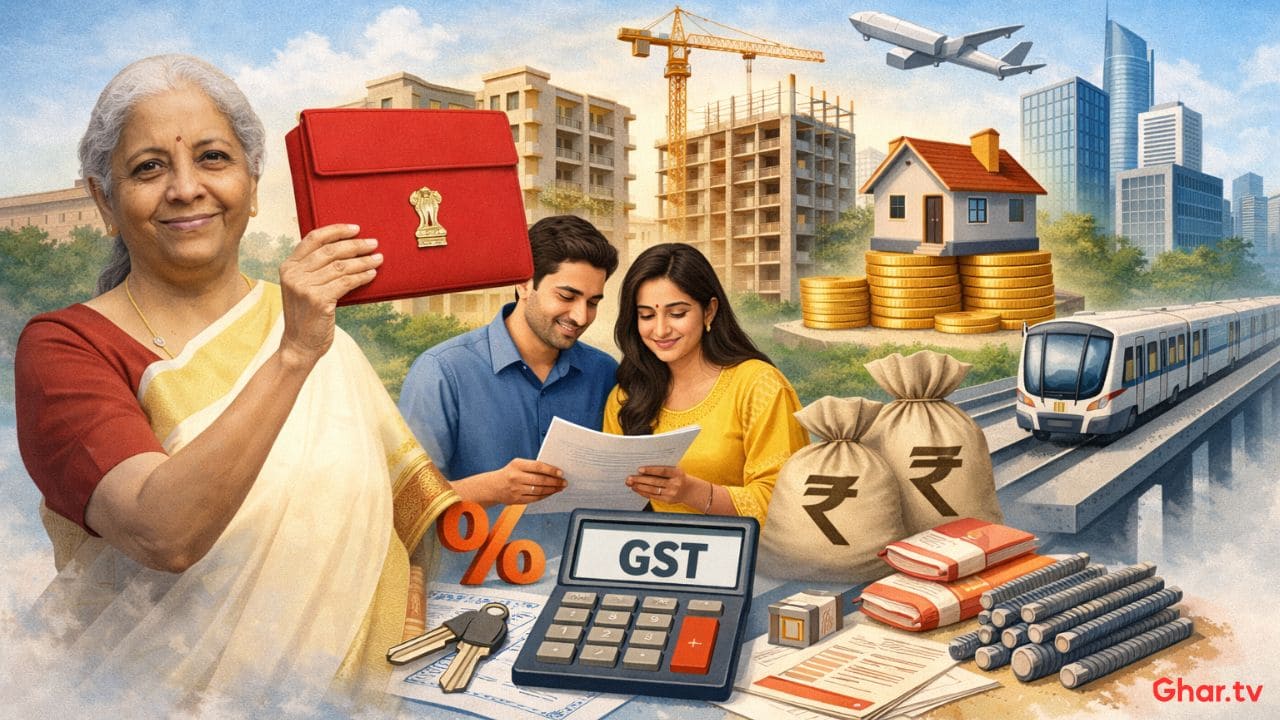
As Finance Minister Nirmala Sitharaman prepares to present her ninth consecutive Union Budget on February 1, 2026, India's real estate sector stands at a critical turning point. The industry is calling for transformative changes that could reshape housing affordability for millions of Indians. Here's everything you need to know about what the real estate sector expects from Budget 2026 and how it might impact your home-buying decisions.
The Current Housing Crisis: Why Budget 2026 Matters More Than Ever
India's housing market is experiencing a paradox. While luxury properties are flying off the shelves, middle-class families are finding it increasingly difficult to afford even basic homes. The numbers tell a concerning story:
- Sales volume dropped 14% in 2025, yet sales value increased by 6% to nearly ₹6 lakh crore
- Homes under ₹50 lakh now represent just 21% of new launches, down from 54% in 2018
- EMI-to-income ratios have jumped from 43% in 2020 to nearly 60% in 2025
- Affordable housing sales have collapsed by 17% year-over-year
What this means for you: If you're a salaried professional looking to buy your first home, you're competing in a market increasingly designed for wealthy buyers. The middle-income housing segment that once catered to the aspirational Indian has nearly vanished.
Top Demand #1: Redefining "Affordable Housing" for Today's Reality
The Problem with the Current Definition
Since 2017, the government has defined "affordable housing" as properties costing up to ₹45 lakh. This hasn't changed in nearly 8 years, despite:
- Land costs rising 40-100% across major cities
- Construction material prices increasing by 35-50%
- Labor costs jumping by 30-40%
What Industry Leaders Are Demanding
CREDAI and NAREDCO are pushing for city-specific affordable housing caps:
| City/Region | Current Cap | Proposed New Cap |
|---|---|---|
| Mumbai & MMR | ₹45 lakh | ₹85-95 lakh |
| Delhi-NCR, Bangalore, Pune, Hyderabad | ₹45 lakh | ₹75 lakh |
| Non-Metro Cities | ₹45 lakh | ₹75 lakh |
Real-world example: In Mumbai's Thane district, even a modest 2BHK apartment of 600 sq ft now costs ₹65-70 lakh. Under current rules, this doesn't qualify as "affordable housing," denying buyers the 1% GST rate (instead of 5%) and other benefits.
The Developer Perspective
Developers currently earn margins of just 10-12% on affordable projects versus 25-30% on luxury developments. Without proper incentives, they're abandoning the affordable segment entirely. New supply of homes below ₹50 lakh has dropped from 52% of launches in 2018 to just 17% in 2025.
Alternative Proposal: CREDAI President Shekhar Patel suggests scrapping the price cap altogether and defining affordable housing by area—90 square meters in metros and 120 square meters in non-metros. This would prevent luxury loopholes while genuinely helping middle-class buyers.
Top Demand #2: Increasing Home Loan Tax Benefits
Current Tax Structure and Its Limitations
Right now, homebuyers can claim:
- ₹2 lakh deduction on home loan interest under Section 24(b)
- ₹1.5 lakh deduction on principal repayment under Section 80C (shared with other investments)
The harsh reality: For a ₹50 lakh home loan at 9% interest, your annual interest payment alone is around ₹4.40 lakh in the first year. The ₹2 lakh deduction covers less than half of this.
What's Being Demanded
Industry bodies are unified in seeking:
- Increase Section 24(b) limit from ₹2 lakh to ₹5 lakh
- Monthly savings for buyers: ₹4,000-8,000
- Particularly beneficial for loans above ₹40 lakh
- Reinstate Section 80EEA (expired in March 2022)
- Provided additional ₹1.5 lakh deduction for first-time buyers
- Targeted homes priced below ₹45 lakh
- Remove the 5-year completion deadline
- Currently, if construction takes longer than 5 years, deduction drops to just ₹30,000
- Many projects face delays due to approvals and regulations
- Extend benefits to new tax regime
- Most taxpayers have migrated to the simplified tax structure
- Currently, these benefits only apply to old tax regime
Practical Impact on Your Pocket
Let's see how increased deductions would help a typical homebuyer:
Case Study: Rahul and Priya, IT professionals in Bangalore
- Home loan amount: ₹60 lakh
- Interest rate: 9% per annum
- Annual interest payment (first year): ₹5.30 lakh
- Tax bracket: 30%
Current Scenario:
- Deduction allowed: ₹2 lakh
- Tax saved: ₹60,000
If Budget 2026 increases limit to ₹5 lakh:
- Deduction allowed: ₹5 lakh
- Tax saved: ₹1,50,000
- Additional savings: ₹90,000 per year
Top Demand #3: GST Rationalization to Reduce Property Prices
Understanding the Current GST Structure
- Affordable housing (under ₹45 lakh): 1% GST
- Under-construction properties (above ₹45 lakh): 5% GST
- Ready-to-move properties: No GST (only stamp duty)
The Hidden Cost Problem
While developers pay 5% GST on under-construction homes, they actually bear:
- 18% GST on construction materials (cement, steel, electrical fittings)
- 18% GST on works contracts (labor contracts, contractor services)
- No Input Tax Credit (ITC) for residential projects
This creates a cascading effect, pushing the effective GST burden to around 23% of construction costs—ultimately passed to buyers.
Example: For a ₹1 crore apartment:
- Official GST at 5%: ₹5 lakh
- Hidden costs due to no ITC: Additional ₹8-10 lakh built into the price
What's Being Demanded
- Reduce GST on works contracts from 18% to 12%
- Allow Input Tax Credit for residential projects
- Maintain 1% GST for expanded affordable housing definition
Expected impact: If implemented, apartment prices could drop by 8-12%, making a ₹1 crore home effectively cost ₹88-92 lakh.
Top Demand #4: Capital Gains Tax Relief for Property Investors
What Changed in Budget 2024
The government removed indexation benefits for properties purchased after July 23, 2024, while reducing Long Term Capital Gains (LTCG) tax from 20% to 12.5%.
Why Investors Are Concerned
Scenario without indexation:
Mr. Sharma bought a property in Pune in 2019:
- Purchase price: ₹50 lakh
- Sale price in 2026: ₹85 lakh
- Gain: ₹35 lakh
- LTCG at 12.5%: ₹4.40 lakh
If indexation was allowed (assuming 6% annual inflation):
- Indexed cost: ₹66.90 lakh
- Real gain: ₹18.10 lakh
- LTCG at 12.5%: ₹2.25 lakh
- Extra tax burden without indexation: ₹2.15 lakh
Industry Demands
- Restore indexation benefits to ensure investors are taxed on real gains, not inflation
- Grandfather provisions for properties purchased before July 2024
- Increase the ₹10 crore cap under Sections 54 and 54F for ultra-luxury properties
PMAY 2.0 and Affordable Housing Schemes: What Needs to Change
Current Status of PMAY-Urban 2.0
Launched in August 2024, the PMAY scheme targets:
- 1 crore houses to be built
- Maximum property value: ₹35 lakh
- Maximum loan amount: ₹25 lakh
The disconnect: In most Tier-I and Tier-II cities, it's nearly impossible to find a decent 2BHK under ₹35 lakh, making the scheme irrelevant for urban buyers.
Proposed CLSS Expansion
The Credit-Linked Subsidy Scheme (CLSS) provided direct interest subsidies to eligible homebuyers. Budget 2026 should:
- Increase annual allocation from current levels to ₹10,000-15,000 crore
- This could assist 1.5-2 million first-time buyers over 5 years
- Raise loan limits to match current prices:
- EWS/LIG: From ₹6 lakh to ₹8-10 lakh
- MIG: From current limits to ₹15-18 lakh
- Simplify application and disbursement to reduce delays
Real impact: For a first-time buyer taking a ₹20 lakh loan, CLSS could provide interest subsidy equivalent to ₹2-3 lakh over the loan tenure, significantly reducing EMI burden.
Commercial Real Estate and REITs: Growth Opportunities
The GCC Boom Driving Office Demand
India now hosts over 1,800 Global Capability Centers (GCCs) employing 2 million professionals and contributing $64 billion annually. These centers are expected to lease 50-55 million square feet by FY27.
What the Commercial Sector Needs
- National GCC Framework with uniform tax incentives for R&D and IP creation
- Definitive GST guidelines for inter-company global services
- Policy stability for the expanding ecosystem
REITs and Investment Democratization
REITs in India currently manage assets worth ₹9.25 lakh crore but represent only 19% of India's listed real estate value. The sector seeks:
- Simplified capital gains treatment for Small and Medium REITs
- Allow mergers of InvITs to consolidate smaller trusts
- Tax incentives for retail participation
Investment opportunity: With SEBI classifying REITs as equity from January 2026, investors face:
- LTCG: 12.5% on gains above ₹1.25 lakh
- STCG: 20%
For investors seeking stable rental income, REITs in Tier-II cities like Lucknow, Indore, and Nagpur offer 6-7% yields.
Infrastructure Push: Metro, RRTS, and Urban Development
Smart Cities Mission Wraps Up
The Smart Cities Mission concluded on March 31, 2025 with:
- 94% of 7,555 projects completed
- ₹47,650 crore disbursed (99.44% of allocated funds)
New Focus: Urban Challenge Fund
Budget 2025-26 announced ₹1 lakh crore total allocation (₹10,000 crore for FY25-26) focusing on:
- Cities as growth hubs
- Creative urban redevelopment
- Water and sanitation infrastructure
Metro Expansion and Property Impact
Metro rail allocation increased 46% to ₹31,250 crore in Budget 2025-26. India's metro network now exceeds 1,000 kilometers across 26 cities.
New RRTS Corridors Approved (November 2025):
- Delhi-Gurugram-SNB-Alwar
- Delhi-Panipat-Karnal
- Combined budget: ₹65,000 crore
Investment strategy: Properties within 500 meters of upcoming metro stations in Mumbai Metro Line 3 corridor, Pune Pink Line, and Bangalore Purple Line extension could see 12-14% appreciation over the next 2-3 years.
Rental Housing: The Missing Market Segment
India's rental housing market remains highly unorganized, with most transactions happening outside formal frameworks.
Key Demands for Rental Housing
- Full tax exemption on rental income up to ₹3 lakh for homes priced below ₹50 lakh
- Rental income exemption from stock-in-trade for 5 years post-construction
- National Rental Housing Mission to develop organized rental stock
- Expand viability gap funding for Tier-II and Tier-III cities
Affordable Rental Housing Complexes (ARHC)
Current scheme targets shelter for 3.5 lakh people with ₹600 crore allocation. Industry seeks expansion particularly for migrant workers and young professionals.
Market opportunity: With 40% of India's population expected to be urban by 2030, organized rental housing presents a ₹2 lakh crore market opportunity.
RERA Enforcement: Making Rules Work Better
While RERA has brought transparency, enforcement remains weak. The industry seeks:
Stricter Compliance Measures
- Automatic interest/compensation for possession delays
- Tighter escrow audits to prevent fund diversion
- True single-window clearance with deemed approvals within 60 days
- Higher penalties for violations that actually deter non-compliance
Industry Status for Broader Housing Sector
Currently limited to affordable housing, granting 'Infrastructure Status' to the entire housing sector would:
- Unlock cheaper credit at infrastructure rates (7-8% vs 10-12%)
- Enable longer tenure loans (up to 20 years)
- Provide tax benefits to developers
- Improve access to institutional funding
Green Building Incentives for Sustainable Development
Current Status
Green building adoption remains limited due to 20-25% higher construction costs. State incentives vary widely:
- Kerala: 50% reduction in building tax for green buildings
- Karnataka: 5% additional FAR for Gold-rated IGBC buildings
Budget 2026 Expectations
- Central subsidy scheme covering 20-25% of incremental eco-friendly costs (capped at ₹1-2 crore per project)
- Accelerated depreciation for green equipment
- GST rationalization on green construction materials
- Additional FAR/FSI benefits for LEED/IGBC certified projects
Buyer benefit: Green homes offer 20-30% lower utility costs, making the premium worthwhile over 5-7 years.
What Different Buyer Segments Should Expect
First-Time Homebuyers (Budget: ₹30-60 lakh)
Watch for:
- Reinstatement of Section 80EEA
- Increased affordable housing cap
- CLSS expansion
Potential savings: ₹2-4 lakh through tax benefits and subsidies
Mid-Income Upgraders (Budget: ₹60 lakh - ₹1.5 crore)
Watch for:
- Section 24(b) increase to ₹5 lakh
- GST rationalization
- Single-window clearance
Potential savings: ₹90,000-1.50 lakh annually through tax benefits
Luxury Buyers (Budget: Above ₹1.5 crore)
Watch for:
- Capital gains tax relief
- Increase in Section 54/54F cap
- Infrastructure status benefits
Potential impact: Better resale value and lower tax on sale
Real Estate Investors
Watch for:
- REIT tax simplification
- Rental income exemptions
- Infrastructure development announcements
Strategy: Focus on micro-markets near upcoming metro stations and GCC hubs
Market Projections: What Happens After Budget 2026
If the government addresses key demands, the impact could be substantial:
Expected Market Movements
- Affordable housing supply could increase from 17% to 40% of new launches
- Private equity investments projected to recover to $4.4 billion in 2026 (28% increase from 2025's $3.5 billion)
- New residential launches expected to exceed 300,000 units
- Infrastructure-connected micro-markets may see 12-14% appreciation
Developer Targets
Top developers including Godrej Properties, DLF, Prestige, and Lodha are targeting ₹1 trillion+ residential sales in FY26.
Interest Rate Scenario
If RBI cuts rates by 50-75 basis points in 2026:
- EMI relief of ₹2,500-4,000 per month on a ₹50 lakh loan
- Improved affordability ratios falling from 60% to 52-55%
- Increased buying activity in mid-income segment
Regional Impact: How Budget 2026 Could Affect Your City
Mumbai Metropolitan Region
Key expectations:
- ₹85-95 lakh affordable housing cap
- Metro Line 3 (Aqua Line) completion benefits
- Improved connectivity driving suburban growth
Investment hotspots: Thane, Kalyan-Dombivli, Panvel
Delhi-NCR
Key expectations:
- ₹75 lakh affordable housing cap
- RRTS corridor benefits
- Air quality improvement measures
Investment hotspots: Gurugram Sectors 70-80, Noida Extension, Greater Noida West
Bangalore
Key expectations:
- Tech sector growth through GCC incentives
- Metro expansion benefits
- Suburban infrastructure development
Investment hotspots: Whitefield Extension, Electronic City Phase II, North Bangalore
Pune
Key expectations:
- Metro completion benefits
- IT corridor expansion
- Affordable housing push
Investment hotspots: Hinjewadi Phase III, Wagholi, Kharadi Extension
Hyderabad
Key expectations:
- GCC framework benefits
- ORR connectivity improvements
- Financial District expansion
Investment hotspots: Kokapet, Narsingi, Gachibowli Extension
Expert Voices: What Industry Leaders Are Saying
Anuj Puri, Chairman, ANAROCK Group: "In 2025, new home sales volumes fell 14%, yet sale value rose 6% to nearly ₹6 lakh crore. This clearly shows that luxury housing is thriving while affordable housing is under stress."
Shekhar Patel, CREDAI National President: "Housing remains a critical engine of economic growth, employment generation, and urban transformation. To keep pace with India's rapid urbanization, it is vital to strengthen affordability, expand access to formal finance, and develop a robust rental housing ecosystem."
Tanuj Shori, CEO, Square Yards: "The Indian housing market is clearly moving out of a luxury-led upcycle and into a more value-driven phase, with the mid-income segment poised to anchor growth as premium demand stabilizes."
Dr. Niranjan Hiranandani, NAREDCO Chairman: "Given inflation and soaring home prices, increasing the home loan interest deduction limit from ₹2 lakh to ₹5 lakh will provide much-needed relief to homeowners."
Conclusion: A Make-or-Break Budget for Indian Real Estate
Union Budget 2026 presents a unique opportunity to reset India's housing market trajectory. The real estate sector—contributing 7-8% of GDP and employing over 70 million people—faces a critical juncture where the middle class is being priced out of homeownership.
The industry's unified demands center on three transformative pillars:
- Updating the 2017 affordable housing definition to reflect urban realities
- Substantially increasing tax deductions to restore housing affordability
- Creating a comprehensive rental housing framework for India's urban migrants
For homebuyers, the stakes are clear: favorable budget announcements could save ₹2-4 lakh for first-timers and ₹90,000-1.50 lakh annually for upgraders. For developers, the right policies could unlock stalled projects worth ₹2 lakh crore.
As February 1, 2026 approaches, all eyes are on Finance Minister Nirmala Sitharaman. Will this budget deliver the "policy recalibration" needed to prevent the affordable housing segment from permanent collapse? Or will it offer only incremental changes that fail to address the structural crisis?
The answer will determine whether India's aspiring middle class can achieve homeownership dreams—or whether real estate becomes an asset class only for the wealthy.


Comments
No comments yet.
Add Your Comment
Thank you, for commenting !!
Your comment is under moderation...
Keep reading blogs