- Blog
- Research & Reports
- Noida
Noida Airport Effect: How Jewar Turned ₹1,650 Into ₹10,500 - And Why a 29–59% Rise Is Still Ahead | Ghar.tv 2020–2027 Data Report
 Priya Kataria
- 2026-03-28 18:36:03
- 1329
- 0
Never miss any update
Join our WhatsApp Channel
The 536% Recalibration: Noida Airport Rewrites NCR's Real Estate Map
In 2020, a square foot of land along the Yamuna Expressway traded for ₹1,650, roughly the cost of a business lunch in Khan Market. By early 2025, that same square foot commands ₹10,500. This 536% surge is not mere appreciation; it is a fundamental recalibration of land value, a direct consequence of the Noida International Airport at Jewar shifting from blueprint to tarmac. This is the sound of a new economic geography being forged. As the airport prepares for its inaugural flights, the market is entering its second, more mature phase of growth.
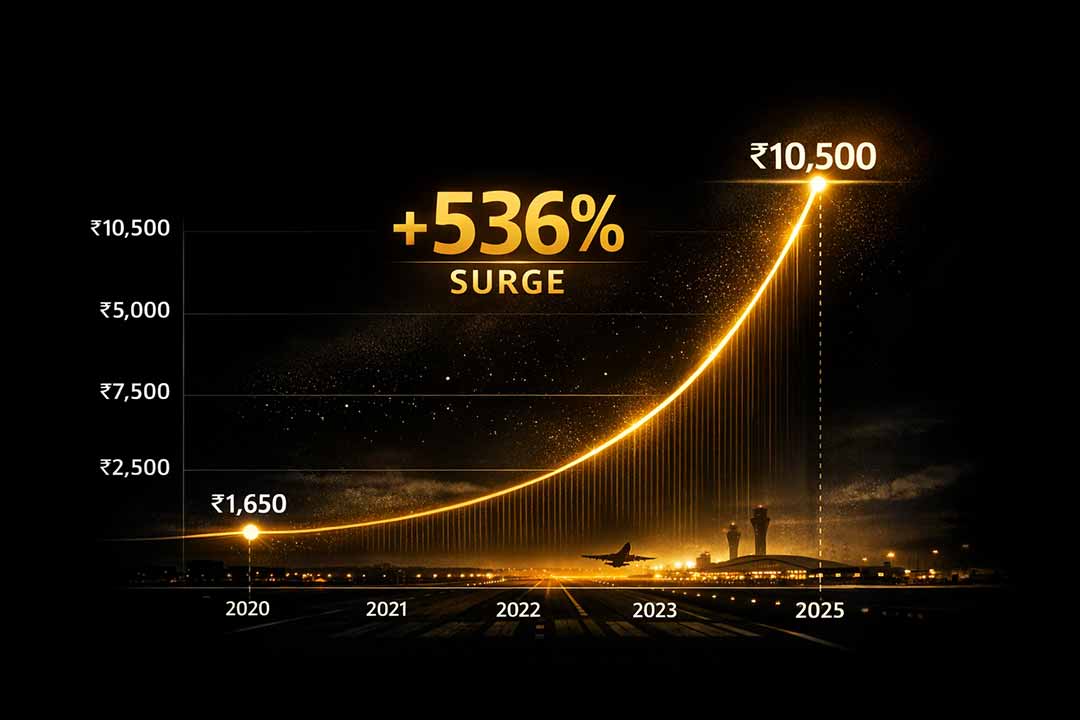
Ghar.tv's definitive intelligence report projects a further 29% to 59% price escalation in this corridor by the end of 2027, a forecast anchored not in speculation, but in the immutable logic of infrastructure-led demand.
This analysis decodes the anatomy of the past surge and maps the precise vectors of future opportunity for capital deployed in India's most-watched infrastructure corridor. For more on market dynamics, read our India Residential Real Estate Market Intelligence Report.
The Jewar Catalyst: More Than an Airport, An Economic Anchor
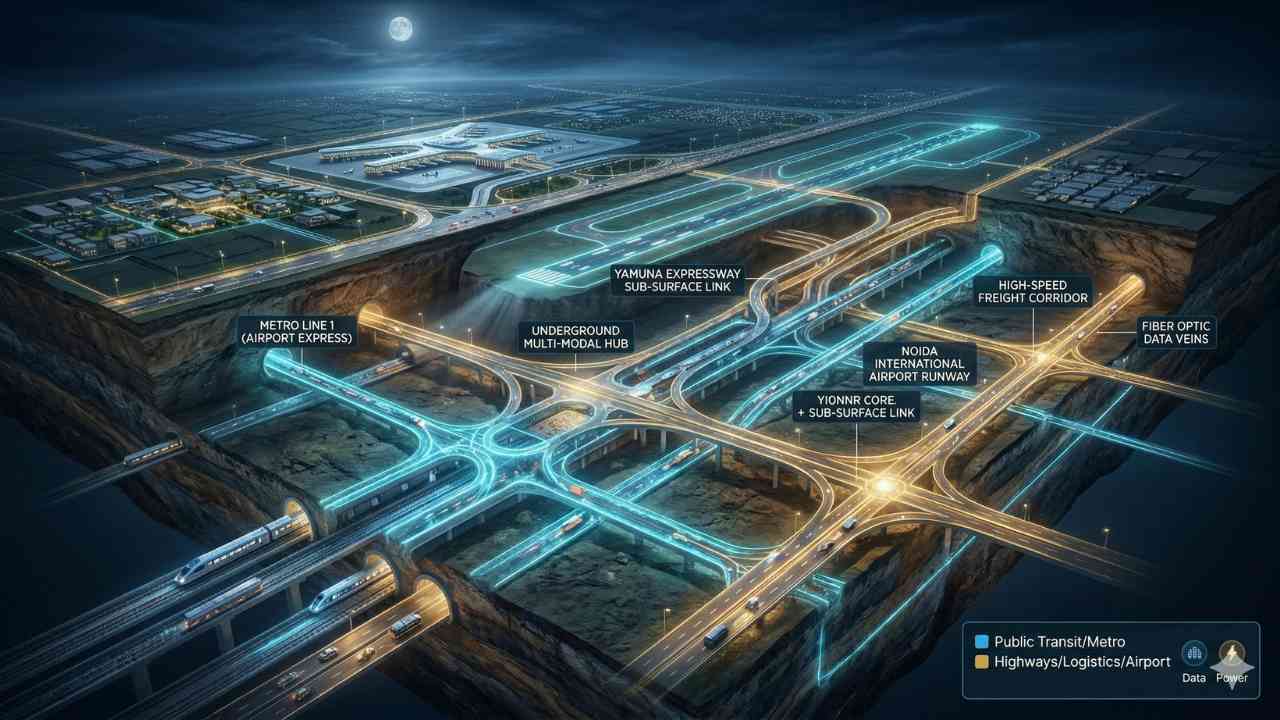
The Noida International Airport is not an aviation project. It is the gravitational core of a new city. To view it simply as a mechanism to de-congest Delhi's IGI Airport is to miss the entire investment thesis. The airport is the anchor tenant for a planned 35,000-hectare aerotropolis, an integrated ecosystem of high-speed logistics, advanced manufacturing, hospitality, and corporate hubs. This strategic master plan transforms the Yamuna Expressway from a transit corridor into a destination, a self-sustaining economic zone.

It's a playbook successfully executed globally, from Dubai South to Incheon. For investors, this provides a crucial insight: the initial land value surge was Phase One, a pure infrastructure arbitrage play. Phase Two, which we are now entering, will be driven by quantifiable job creation and demographic influx. This distinction is critical to understanding the sustained growth projected through 2027 and beyond. The impact of such large projects is also seen in other regions, like the dramatic price surge along Yamuna Expressway.
The Anatomy of a Surge: Deconstructing the 2020-2025 Price Explosion
The period between 2020 and 2025 was a masterclass in how a single, large-scale infrastructure trigger can re-price an entire region. The data, however, reveals a clear hierarchy of returns, separating the asset classes that captured the pure infrastructure premium from those that rode the broader sentiment wave. The pattern is instructive for future capital allocation.
The 536% Equation: How Land Outpaced Apartments by 3.4x
The most potent value unlocking occurred in land parcels directly flanking the Yamuna Expressway. Plot values, starting from a low base of ₹1,650 per sq ft in 2020, escalated to ₹10,500 per sq ft by 2025, delivering a staggering 536% return. In the same corridor, residential apartments also performed exceptionally well, but their appreciation was a more moderate 158%, moving from ₹3,950 per sq ft to ₹10,200 per sq ft. This 3.4x performance gap between land and built-up property is the single most important data point from the last five years. It confirms that early-stage investors who acquired land made a direct, undiluted bet on the airport's materialisation.
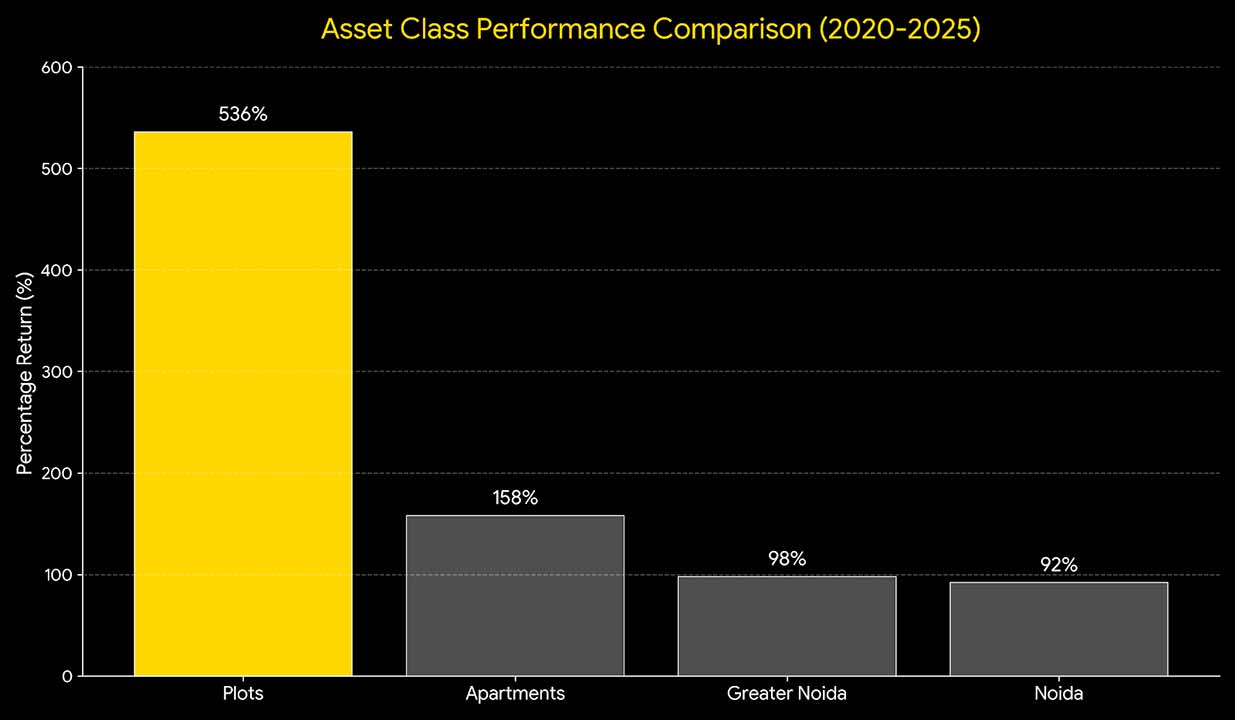
Apartment values, by contrast, priced in factors of immediate livability, maintenance, and existing social infrastructure, thus muting the pure-play infrastructure upside. The broader markets of Greater Noida and Noida, while benefiting from the ripple effect, posted healthy but comparatively modest gains of 98% and 92% respectively. Their growth was a function of regional sentiment, whereas the Yamuna Expressway's was a function of a direct catalyst. We see similar price increases in other major markets, as detailed in this report on soaring property prices.
| Corridor / Market | Asset Type | Avg. Price 2020 (₹/sq ft) | Avg. Price 2025 (₹/sq ft) | 5-Year Appreciation (%) |
|---|---|---|---|---|
| Yamuna Expressway | Plots | ₹1,650 | ₹10,500 | 536% |
| Yamuna Expressway | Apartments | ₹3,950 | ₹10,200 | 158% |
| Greater Noida | Residential | ₹3,340 | ₹6,600 | 98% |
| Noida (Overall) | Residential | ₹4,795 | ₹9,200 | 92% |
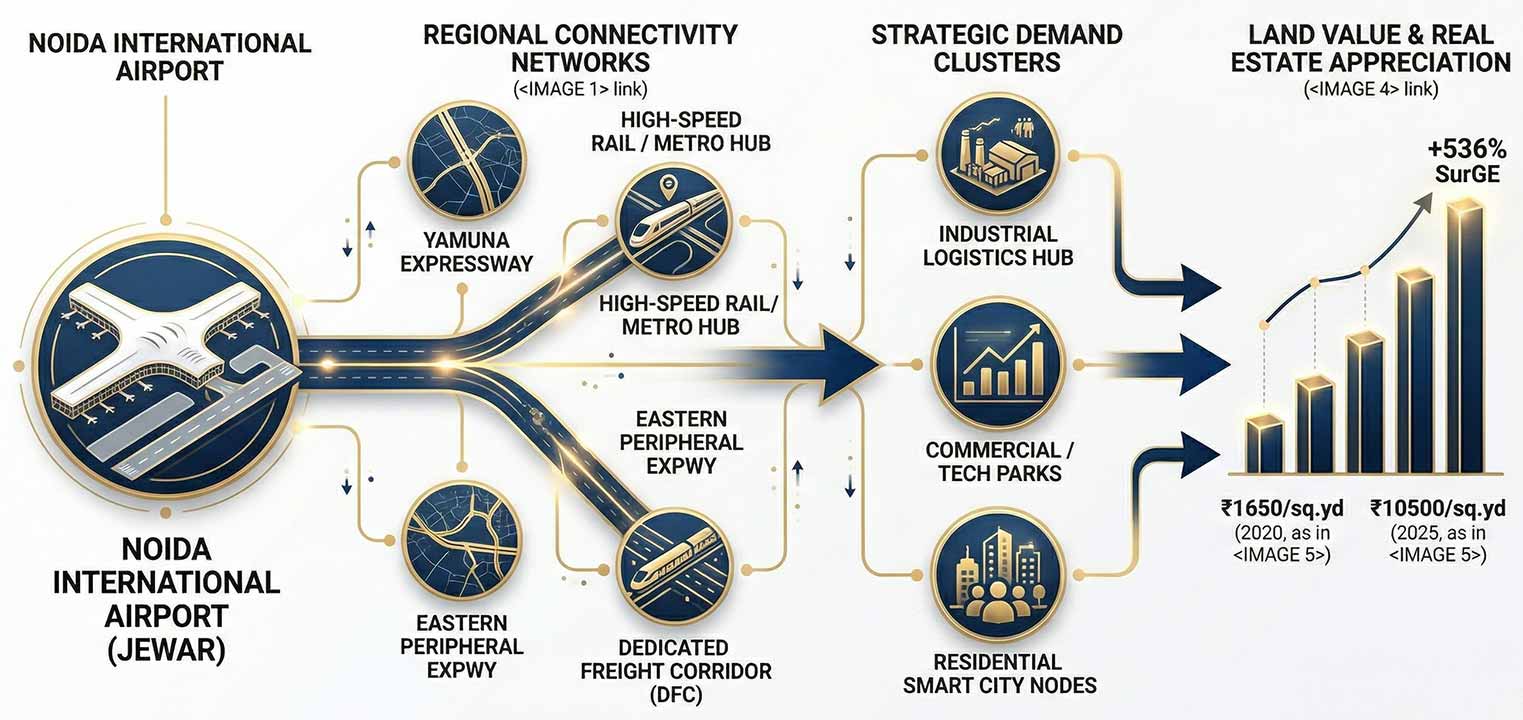
Two conclusions emerge from this data. First, proximity to the catalyst was the primary determinant of returns, making the Yamuna Expressway the undisputed epicentre of value creation. Second, the asset class mattered immensely. The phenomenal growth in plot values establishes this corridor as a premier zone for high-growth, patient capital. The broader Noida market offers more stable, end-user-driven returns, a different product for a different risk profile.
Beyond the Average: Unpacking Chi 3's Ten-Fold Price Explosion
Averages can mask the real story. A granular analysis of micro-markets reveals pockets of hyper-appreciation where informed investors generated alpha far exceeding the corridor's 536% average. The standout performer is the Chi 3 sector, where land values didn't just rise; they multiplied. From ₹1,200 per sq ft in 2020, prices exploded to ₹12,950 per sq ft by 2025-a more than ten-fold increase. This wasn't random. Chi 3's strategic location, clear land titles, and planned connectivity to the airport's commercial zones made it a focal point for institutional and HNI interest. Other sectors like 22D and Chi Phi also delivered returns north of 400%, confirming a pattern: well-planned sectors with superior infrastructure access captured the lion's share of the gains.
Further afield, in the more established residential belts of Greater Noida, sectors like Omega II (43%), Chi V (41%), and Zeta I (38%) posted robust appreciation between 2022 and 2025. This consistent performance signals a maturing market, where growth is now also supported by rising end-user demand and rental yields, as seen in the 12% YoY rental climb in prime locations like Sector 150, Noida. The speculative developments along the expressway are also driving growth, as detailed in this analysis of speculative property developments.
| Micro-Market | Parent Region | Asset Type | Key Appreciation Metric | Time Period |
|---|---|---|---|---|
| Chi 3 | Yamuna Expressway | Land | >10x (from ₹1,200 to ₹12,950/sq ft) | 2020-2025 |
| Sector 22D / Chi Phi | Yamuna Expressway | Land | >400% | 2020-2025 |
| Sector Omega II | Greater Noida | Residential | 43% | 2022-2025 |
| Sector Chi V | Greater Noida | Residential | 41% | 2022-2025 |
| Sector Zeta I | Greater Noida | Residential | 38% | 2022-2025 |
This micro-market data provides a clear investment roadmap. For portfolios targeting maximum capital gains, land in hyper-growth sectors like Chi 3 remains the play, albeit with a higher entry point now. For balanced portfolios seeking a blend of appreciation and future rental income, the established sectors of Jaypee Greens offer a compelling, lower-risk alternative.
The Forward Outlook: Price Projections for 2027
The historical performance is compelling, but investors deploy capital based on future potential. As the Noida Airport transitions from a construction project to an operational economic engine, the property market is poised for its next leg up. Our projections, based on infrastructure completion timelines, planned commercial development, and supply-demand dynamics, forecast significant price escalations by the end of 2027. The growth, however, will be more nuanced than the initial speculative surge.
Yamuna Expressway: Leading the Next Wave with 29-59% Growth
The Yamuna Expressway corridor is projected to continue its leadership, with property prices forecast to rise by 29% to 59% from 2024 levels. This will take the average rate from ₹6,500 per sq ft to a range of ₹8,700 to ₹10,500 per sq ft by 2027. The lower end of this range represents a conservative scenario tied to airport operations, while the upper end factors in the accelerated development of ancillary logistics and hospitality projects. This growth phase will be less about land speculation and more about the first signs of genuine economic activity and employment generation.
The more mature Noida Expressway corridor is forecast to appreciate by 19% to 43%, while new launches in central Noida, which already command a premium, are expected to grow by 20% to 47%. This indicates a healthy, multi-tiered market where different corridors offer different risk-return profiles. Investors can track these movements against the latest reasons why property prices continue to increase to identify entry points.
| Corridor / Market | Avg. Price 2024 (₹/sq ft) | Projected Price Range 2027 (₹/sq ft) | Projected Increase (%) |
|---|---|---|---|
| Yamuna Expressway | ₹6,500 | ₹8,700 – ₹10,500 | 29% – 59% |
| Noida Expressway | ₹8,500 | ₹10,500 – ₹13,000 | 19% – 43% |
| Noida (New Launches) | ₹14,500 | ₹19,000 – ₹25,000 | 20% – 47% |
| Delhi-NCR (Average) | ₹8,900 |
₹11,100 – ₹13,350 |
25% – 50% |
This forecast presents a clear strategic choice. The Yamuna Expressway remains the high-alpha play, suitable for investors focused purely on capital appreciation. The Noida Expressway and central Noida offer a more balanced investment thesis, with strong potential gains anchored by robust end-user demand and existing social infrastructure, appealing to those with a more conservative risk appetite. The impact of infrastructure on real estate is a key theme, also seen in the 9 reasons NMIA's opening is driving a surge.
The Market's Undercurrents: Supply, Demand, and the Premium Pivot
Beyond the airport, two powerful market fundamentals are providing tailwinds for sustained price growth across the entire Noida region: a severe supply contraction and a definitive shift towards premiumisation.
The Supply Squeeze: Why Noida's Vanishing Inventory is a Price Rocket
The single most potent factor supporting future price hikes is the dramatic reduction in available housing stock. Unsold inventory in Noida plummeted by a staggering 72% between Q1 2020 and Q1 2025, leaving a mere 5,012 units available. Greater Noida West saw a similar 56% decline. This is not a slowdown; it is a supply squeeze. When coupled with surging demand, evidenced by home sales worth ₹3,291 crore in Q3 2024 alone (a 62% YoY increase), the outcome is inevitable upward price pressure.
This supply-side constraint alone provides a floor to valuations and is expected to drive prices up by an additional 20-30% by 2027, independent of the airport catalyst. A deeper look at the Delhi-NCR property market confirms this is a region-wide trend, but most acute in Noida.
The Premium Pivot: A Structural Shift in Market Character
Simultaneously, the character of Noida's real estate market is undergoing a structural transformation. Once dominated by the affordable housing segment, the region is now a hotspot for luxury and premium developments. In 2024, an incredible 59% of new launches in Delhi-NCR were in the luxury segment (priced above ₹2.5 crore), a massive leap from 24% in 2023. In Noida, this trend is led by upscale sectors like 107, 128, and 150, where the focus is now on larger 3 and 4 BHK configurations.
The average ticket size has crossed ₹1.05 crore. This pivot to premiumisation does more than just lift average prices; it fundamentally enhances the profile of the micro-market, attracting a more affluent demographic and signaling developer confidence in the region's long-term economic prospects. The growth in NCR is also reflected in other major hubs, such as the commercial project planned in Noida.
The Final Verdict: From Infrastructure Bet to Economic Ecosystem
The investment case for the Noida airport corridor is no longer a question of 'if' but 'how'. The initial, explosive phase of land value discovery is now maturing into a more complex play on ecosystem development. An investment made today is not a speculative punt on an airport's construction; it is a strategic stake in the creation of NCR's third economic pole, a worthy successor to Gurugram and Noida itself.
The data from 2020-2025 provides an unequivocal testament to the power of a singular infrastructure catalyst. The projections for 2027 signal a second, more sustainable phase of growth, driven by job creation and a tightening supply-demand imbalance.
The question for capital is no longer whether to participate, but where to position on the risk-reward spectrum: in the high-octane land plays of the immediate corridor, or the steady, demand-backed residential assets in its widening ripple zone. The airport's runway is built; the flight path for capital is now being defined. For those looking at land investment potential, the Yamuna Expressway real estate remains a key focus area.



Comments
No comments yet.
Add Your Comment
Thank you, for commenting !!
Your comment is under moderation...
Keep reading blogs