Haryana Affordable Housing Rates Increase: Supply Boost or Cost Rise?
 Sachin Waghmare
- 2026-03-27 18:05:38
- 1241
- 0
Never miss any update
Join our WhatsApp Channel
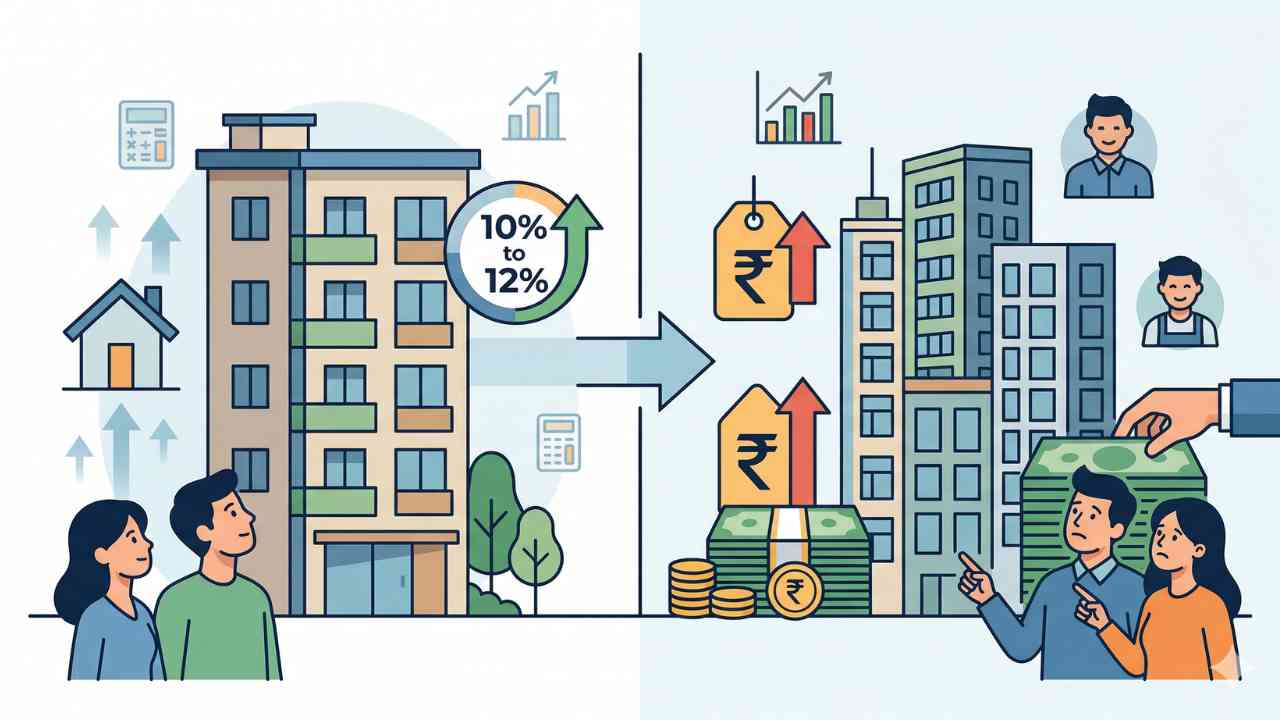
Haryana: The Haryana government enacted a mandated upward revision of allotment rates under its Affordable Housing Policy-2013 by approximately 10% to 12%, a directional shift aimed at developer viability. This adjustment raises the base carpet area rate ceiling across major urban centers to between ₹4,250 and ₹5,575 per square foot. Real estate analysts project this measure will increase the final cost to homebuyers by roughly ₹3 to ₹4 lakh per apartment unit.
Haryana Affordable Housing Rate Adjustment Details
The government has formalized the change to incentivize stalled group housing projects throughout the region. The Cabinet, chaired by Chief Minister Nayab Singh Saini this week, approved the amendment leveraging provisions within the Haryana Development and Regulation of Urban Areas Act, 1975.
| Micro-Market/Town Category | Old Rate (Per Sq. Ft) | Revised Rate (Per Sq. Ft) |
|---|---|---|
| Gurugram (Highest Tier) | ₹5,000 | ₹5,575 |
| Faridabad & Sohna | ₹5,000 & ₹4,500 | ₹5,450 |
| High/Medium Potential Towns | Not Specified | ₹5,050 |
| Low Potential Towns | Not Specified | ₹4,250 |
| Balcony Rate Increase | ₹1,200 | ₹1,300 (Max Cap ₹1.30 lakh) |
Developer Viability and Rising Construction Costs
This 10–12% adjustment is designed to address severe margin compression developers have faced due to inflationary inputs. Escalating expenses for raw materials like cement and steel, coupled with higher labor charges, have rendered many existing caps economically unviable. The previous allotment structure, established in 2013 and adjusted last in 2021 and 2023, no longer mirrored contemporary market expenditure. The government confirmed that the revised rates apply to all licenses under the policy that have not yet completed the allotment process as of the notification date.
Industry leaders maintain that while the revision is necessary, further alignment with present-day construction realities is essential for sustained output. A complete upward recalibration is required to truly revive the affordable housing mission across the State of Haryana. This initiative, however, does successfully address mounting developer concerns regarding rising input costs in NCR. Developers in nearby regions often look to policy changes here, such as the Delhi NCR development suspension threats.
Market Implications for Housing Supply
The primary market indicator derived from this revision is an expected uptick in project commencement and completion rates. Developers anticipate that greater profitability under the updated framework will unlock inventory that was otherwise shelved. Analysts suggest that the increased supply, though marginally priced higher for end-users, ultimately benefits middle-class aspirational buyers by providing accessible inventory sooner. For instance, projects in Faridabad might see faster launches, similar to the recent Omaxe sales velocity achievement.
The ruling clarifies that ongoing projects where the Town and Country Planning Department finalized allotments previously remain insulated from the price increase. Furthermore, the decision underscores the administration’s commitment to maintaining momentum in the affordable segment, a critical component of urban housing stock. The government is also actively working to resolve stuck inventory, as seen with the SWAMIH initiative progress updates.
Analysis of the Policy Shift in Haryana Real Estate
The rate hike for properties in Gurugram has pushed the ceiling to ₹5,575 per square foot for standard carpet area units. This specific increase acknowledges the significantly higher land acquisition and development expenses inherent to the National Capital Region's primary commercial hub. Property experts estimate that the additional financial burden per purchaser will translate to an outlay increase of ₹3 to ₹4 lakh. Buyers looking at specific high-value areas might research property in Nirvana Country, Gurgaon.
For the targeted beneficiaries, ensuring homes become available and are delivered expeditiously is paramount. One senior executive stated that increased affordability realization for the buyer hinges on the subsequent volume of new launches stimulated by this fiscal viability. The administrative move provides critical relief to developers grappling with market pressures since late 2023. This policy adjustment is part of a broader trend concerning stakeholder roles in affordable housing.
Outlook for Affordable Housing Sector
Looking ahead into the first half of the next fiscal year, market activity in the Haryana affordable housing segment is positioned for a moderate expansion. Continued monitoring of supply pipeline absorption rates will be necessary to gauge the true effectiveness of this intervention. The government's action suggests a proactive stance toward balancing developer sustainability with subsidized home provision. Developers in Greater Noida, a neighboring market, are also seeing significant activity, such as launches in Sector Pi II Greater Noida West.
This governmental action confirms the administration’s intent to support development pipelines facing cost inflation within Haryana. The resulting upward adjustment in housing prices, while immediate, is intended to catalyze greater long-term housing availability across major districts. Investors should also track the overall health of the national affordable housing schemes, like the one detailed in guide to government housing schemes.
Disclaimer: This article is based on publicly available information and media reports. Ghar.tv does not independently verify all facts and figures mentioned. Readers are advised to conduct their own due diligence before making any investment or business decisions based on this information. The content is for informational purposes only and should not be construed as financial, legal, or professional advice.


Comments
No comments yet.
Add Your Comment
Thank you, for commenting !!
Your comment is under moderation...
Keep reading blogs